Count-model demonstration
The code fits I_Count ~ Culture + offset(log(Total_Words)) with a Poisson family. The offset models counts relative to report length. This is a useful statistical example when clearly identified as synthetic.
03 / Honors capstone · Research design & simulation
Dreaming in Different Cultures explores a cross-cultural research question. The recovered materials document a proposed DreamBank analysis and a synthetic count-model demonstration; empirical cultural findings remain unverified.
The research question
My capstone proposed comparing American, Japanese, and Peruvian DreamBank narratives through text preparation, pronoun rates, topic exploration, and count models. It asks how to make language features comparable when report lengths and sample sizes differ.
The recovered code establishes a narrower completed demonstration: generating synthetic counts and fitting a length-adjusted Poisson model. It does not establish an observed cultural difference.
Evidence status
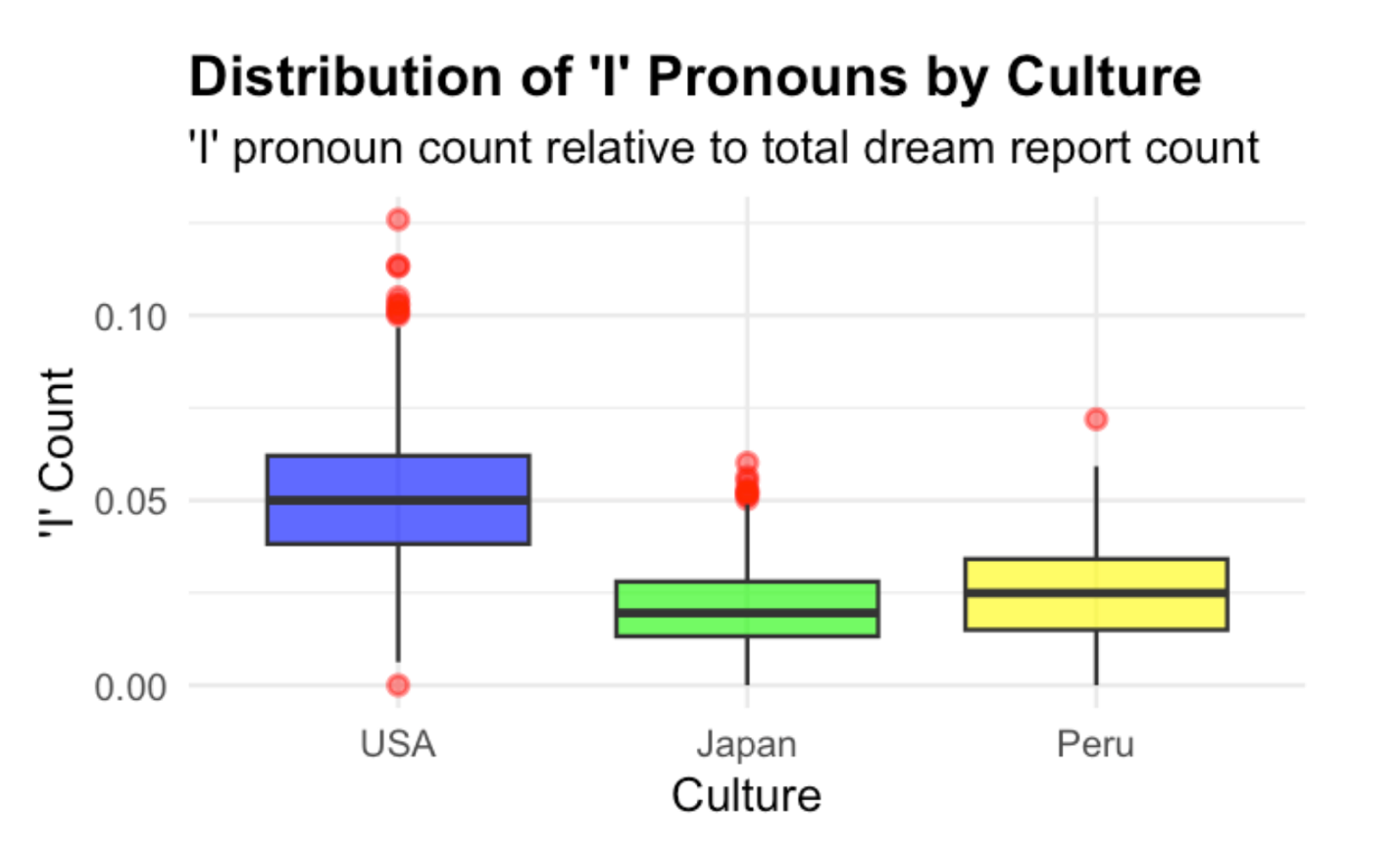
The recovered USE_THIS_CODE.Rmd sets a seed, simulates report lengths, and generates first-person counts with different rates assigned to the group labels. It does not import dream narratives or an observed feature table.
| Group label | Generated rows | Imposed expected count per word | Meaning |
|---|---|---|---|
| USA | 1,000 | 0.050 | Assigned higher rate |
| Japan | 300 | 0.020 | Assigned lower rate |
| Peru | 300 | 0.025 | Assigned lower rate |
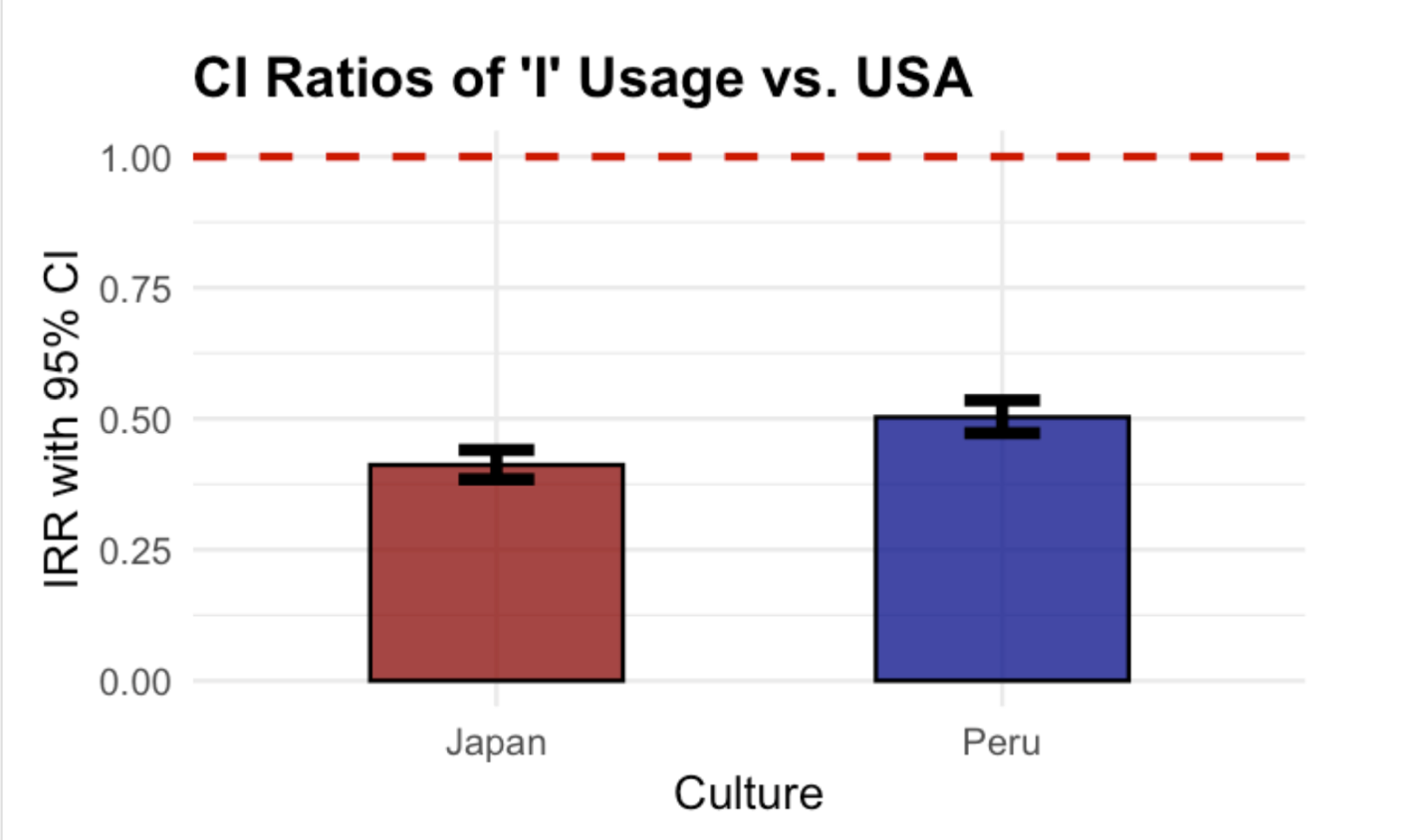
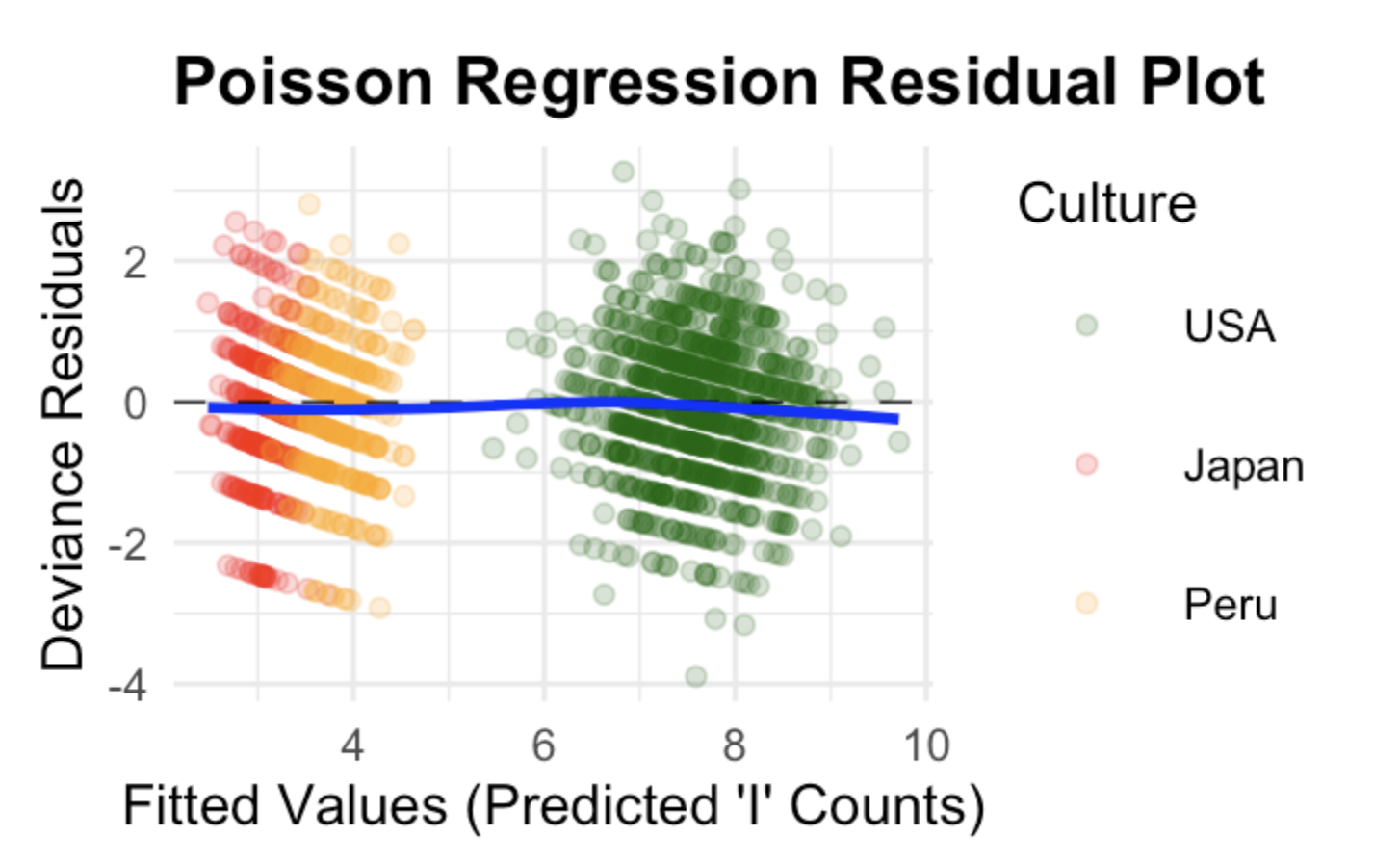
Interpretation: A fitted difference on these generated data reflects the simulation design. Its coefficients, intervals, and residual plots cannot validate a finding about actual American, Japanese, or Peruvian students.
The code fits I_Count ~ Culture + offset(log(Total_Words)) with a Poisson family. The offset models counts relative to report length. This is a useful statistical example when clearly identified as synthetic.
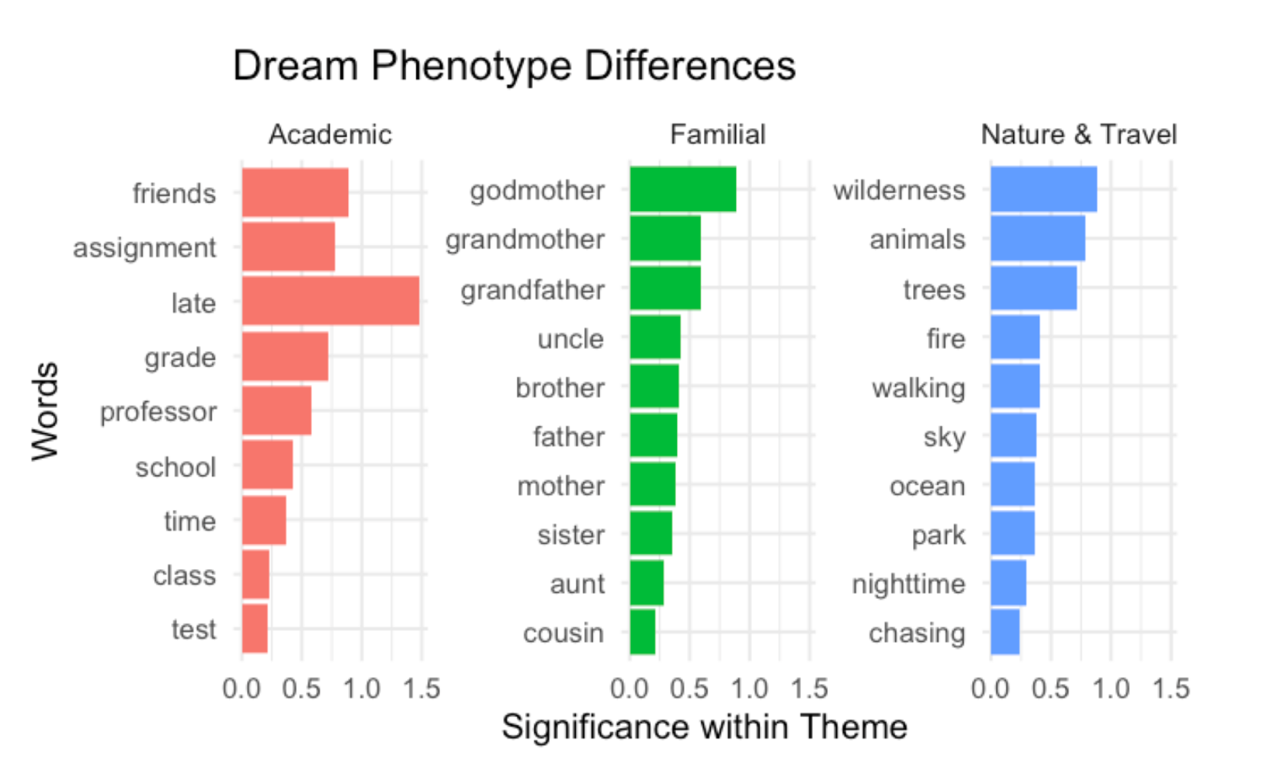
The object lda_mock combines manually selected words with runif() weights. It does not call an LDA fitting routine. Academic, Familial, and Nature & Travel are illustration labels, not recovered fitted topics.
The final paper describes empirical DreamBank findings. Its figure titles, styling, and qualitative rate pattern correspond to the supplied simulation code. Without the empirical inputs and final run, those figures are treated as simulation-associated illustrations, not empirical evidence.
Neither recovered CURE script supplies a permutation-test implementation or saved permutation output. The DreamBank draft also has acquisition, syntax, cohort-selection, and topic-summary dependencies that prevent an independent empirical run.
All four figures below are illustrative and are not used to support cultural conclusions. They are retained unchanged from the source paper. The exact R-generated images and fitted numbers have not been regenerated in this environment.
SIMULATION-ASSOCIATED ILLUSTRATION · EMPIRICAL PROVENANCE UNVERIFIED
SIMULATION-ASSOCIATED ILLUSTRATION · EMPIRICAL PROVENANCE UNVERIFIED
SIMULATION-ASSOCIATED ILLUSTRATION · EMPIRICAL PROVENANCE UNVERIFIED
SIMULATION-ASSOCIATED ILLUSTRATION · EMPIRICAL PROVENANCE UNVERIFIED
Research design & completion requirements
The proposal outlines text cleaning, LDA, pronoun comparisons, count modeling, and resampling. Those are planned analytical steps. The synthetic demonstration must remain separate from any future analysis of observed reports.
Current boundary: This page demonstrates research planning and a statistical simulation. It does not claim a completed empirical NLP study, cultural prediction model, or validated difference in self-focus.
Honors SCP.Rmd is byte-identical to the earlier Updated_Code.Rmd. It is not new independent evidence. Both previously supplied DreamSAT workbooks contain zero project totals and division errors; their norm columns are reference values. They remain excluded as results evidence.
The paper’s “final” filename and the proposal’s intended sample sizes do not substitute for observed cohort counts or executed empirical outputs.
Inspect the materials
The supplied final paper remains a reporting artifact with unverified empirical claims; the proposal describes intended work. Their evidence roles are summarized in the provenance review. The newly supplied full PDFs are not republished.